The Evolutions of Political Parties: Studying the Founders, Part III

This is the third in a series analyzing historian Richard Hofstadter’s 1969 book, The Idea of a Party System. During a period when progressives’ frustration with the Democratic Party seeks constructive resolution, it is worth looking at the historical evolution of parties under the leadership of the Founders, whose very fears about political parties quickly became reality.

You can read Part I here, and Part II here.

Part III: The Adams Administration

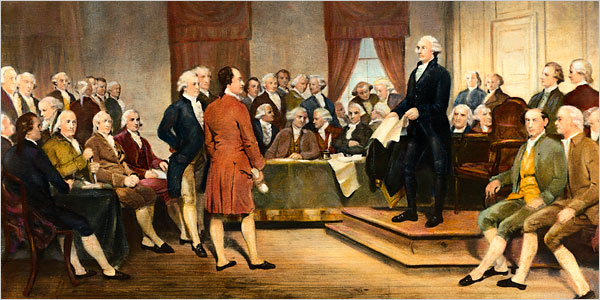
In Parts I and II we looked at the Founders’ disdain for political parties and factions, why Madison and others believed their influence could be mitigated, and how the French Revolution created the first partisan crisis of the young republic.  Now we turn our attention to John Adams, who could not claim President Washington’s pretense of non-partisan governance, though that hue by the end of his second term.

The behavior of the Federalist Party in the late 1790s eerily foreshadowed the Bush-era Republicans.  As tensions mounted with France, and the Anglophiles that ran the Federalist Party ratcheted up hysteria over France’s many diplomatic blunders, hoping to turn the American public sharply against the French, and, in turn, against the Republican Party.   The notorious Alien and Sedition Acts, which passed Congress narrowly (44-41) in 1798:

“{W}as vague enough to make a man criminally liable for almost any criticism of the government or its leading officers or anyeffort to combine for such a purpose…It drew no definable distinction between criticism and defamation, opposition and subversion”(p.107).

Hofstadter has praised the innovation of the Founding Fathers for creating the first legitimate political opposition under a republican framework, but he acknowledges that the Sedition Act was a major threat to its development.   Federalists hoped to cow Republican dissent by criminalizing their pro-French rhetoric.  It is a testament to President Adams that he was able to buck the “High Federalists”, who agitated feverishly for war, and ultimately decide against it, believing that the United States was too fragile a country to launch a costly war with its populace so bitterly divided.

Meanwhile, morale was down in the Republican camp, even as they continued to make gains in Congressional elections throughout the 1790s.  Jefferson encouraged his party to look past the election of Adams to the presidency, and bear with this Constitutional experiment, even as some of his peers speculated on secession:

“{I}n every free and deliberating society, there must, from the nature of man, be opposite parties, and violent dissensions and discords; and one of these, for the most part, must prevail over the other for a longer or shorter period of time.  Perhaps this party division is necessary to induce each to watch and relate to the people the proceedings of the other”(p.115).

For those of us reeling from the 2010 midterms, or indeed, for Republicans who were stunned by their repudiation in 2008, Jefferson’s passage should remind us all that in a democracy the side one supports will inherently lose the trust of the people in time, for any other result would be an indictment of the democracy’s vibrancy.   It is the responsibility of the party to bring the inadequacies of its opponents to light, and sell the people on why governing in an alternative manner would be preferable to their interests.

Jefferson continued:

“A little patience and we shall see the reign of witches pass over, their spells dissolved, and the people recovering their true sight, restoring their government to its true principles…If the game runs against us sometimes at home, we must have patience until the luck turns, and then we shall have an opportunity of winning back the PRINCIPLES we have lost.  For this is a game where the principles are the stake”(p.117).

Folks, even in these times, the reign of witches will pass over, and their spells will dissolve.

For progressives who share my optimism about emerging demographic trends, including the socially liberal inclinations of the internet generation, the growing number of Hispanic voters and the passage of fundamentalism’s high-water mark, Jefferson had similar, and ultimately correct, assumptions about demographics in his own time.   He admonished Republicans to put away thoughts of secession or violence, and to stick with the democratic experiment.

Meanwhile, President Adams was finding out the lesson George W. Bush never had to- that a public’s appetite for war is easily lost by an accompanying tax increase.   The Republicans seized on this issue, and Adams, even as he had avoided war, was hammered over his party’s proposal for a burdensome war tax.  It soon became evident that the Republicans were cruising to electoral victory in 1800.

Now the Republicans, who had suffered such persecution as the minority party, would have the chance to govern.  But, as Hofstadter explains:
“{E}ven their  own experience as an opposition, however educative, had not fully reconciled them to the necessity of an opposition…”
Their own war to wipe out the Federalist Party for good was on the march.
Posted in Political ramblings | Tagged , , , | 5 Comments

The Evolution of Political Parties- Studying the Founders, Part II

This is the second in a series analyzing historian Richard Hofstadter’s 1969 book, The Idea of a Party System. During a period when progressives’ frustration with the Democratic Party seeks constructive resolution, it is worth looking at the historical evolution of parties under the leadership of the Founders, whose very fears about political parties quickly became reality.

You can read Part I here.

——————————————————

Part II:  Fissures  Emerge During Washington’s Presidency

“We can be sure that those with power in their hands…will always, when they can…increase it.” – George Mason

In creating a government that would balance liberty and stability, the Founders were fairly unified in their belief that checks on government power should be built into the Constitution, rather than established through the volatile political process.  The Founders, explains Hofstadter, did not expect permanent political parties to play a significant role governance, but did want to establish checks to limit a faction’s potential power.  These checks include the three separate branches of government, the bicameral legislature, freedom of the press,  and so on.

In Federalist 51, Madison argued that the diffusion of sects and interests in the United States would prevent one sect from exerting majority rule, both in religious and civil life.  Read in concert with Federalist 10, in which he argued counter-intuitively that a large, extensive representative republic would be best equipped to prevent majoritarian tyranny, Madison banks on the notion that while factions would arise, under the Constitution they would not be able to garner sufficient support to establish lasting majority power. Having previously observed a host of small parties, working independently in their various states, Madison did not foresee the creation of two major parties, which was catalyzed by the national debate over the Constitution.

It is true to this day that there are many competing sects and ideologies in American politics.  Every election cycle witnesses primary battles along lines of social and economic liberalism (or conservatism), the role of libertarianism, religion, environmentalism, energy production, urban interests, the influence of corporate power and labor unions.   Instead of all exerting their influence as distinct and weak individual factions, however, they debate within the framework of the Democratic and Republican parties.   The utility of having these grand formations, these ‘big tents’, makes sense in retrospect.  But how did they come to be, and how did the first majority party, the Republicans, emerge under the leadership of James Madison himself?

In the early 1790s, as anti-Federalists increasingly coalesced into Jefferson and Madison’s Republican Party, Madison began to view the role of parties in the constitutional framework differently.   He now saw political parties as checks on each other, having conceded their existence in the political system.  He considered the governing Federalists “more partial to the opulent than to the other classes of society” and governing through “the influence of money and emoluments and the terror of military force”(p.82), while his oppositional party represented the common good.

Madison’s perspective, which progressives often tout today, is that the views of his party were in line with the majority of the people, but the Federalists, “being the weaker in numbers, would try to strengthen itself with the influential, particularly the moneyed men, the most active and insinuating influence”(p.83).  Madison warned that a minority party, bolstered by money, would work to unravel a majority coalition through exploiting prejudices and distracting the public from matters of primary concern.  In fact, Madison’s essays in the early 1790s abandoned his Federalist Paper-era concern with majority rule, and now turned to the pernicious ability of political parties to run the nation from the minority position. Anyone who has lived through the last two years can relate to that.

Other than the creation of a National Bank, Alexander Hamilton’s major initiative, domestic politics were rather non-controversial in the early years of the republic.  The first major Congressional fissure came over support for the French Revolution.  Republicans, who supported the revolutions, were labeled as anti-property radicals by Federalists, who were in turned called “Monocrats” for their alleged aspirations to restore the French monarchy.   The French Revolution polarized the two major political factions to such an extent that by 1797, Jefferson reported:

“Men who have been intimate all their lives cross the street to avoid meeting, and turn their heads another way, lest should they be obliged to touch their hats.”

One character we’ve yet to come across in this discussion in George Washington.  He suffered terribly though these years, after thinking his near-unanimous election in 1788 was a mandate for non-partisanship.  He had attempted to keep a balanced cabinet, but with the departures of Secretary of State Jefferson and Attorney General Edmund Randolph, by his second term the team was decidedly Hamiltonian, and Republican forces around the country no longer considered him off-limits politically.   In response, Washington blasted Republicans for fomenting the Whiskey Rebellion and trying to sink the Jay Treaty, and dangerously walked the line tying political opposition to sedition.  As Hofstadter explained, the American system could only work if both the ruling party and the opposition recognized each other’s legitimacy, and by the mid-1790s, this was breaking down.

In fact, Washington’s much-praised Farewell Address, written by Alexander Hamilton, was considered then a slap-down of the Republican Party.   Washington’s denouncement of factions implicates the Jeffersonian opposition, but he considered himself “a man above party”.  He cautioned people to “steadily discountenance irregular oppositions to the acknowledged authority of government”(p.98).   Failing to define “irregular opposition”, Washington was essentially telling the American people that his people running the government should not be undermined by a pernicious opposition, hardly the “let’s all get along” ethos the speech is remembered for.

Thank you for reading.  On Saturday I’ll post Part III: The Adams Administration.


Posted in Political ramblings | Tagged , , , , | 7 Comments

The Evolution of Political Parties- Studying Hofstadter and the Founders

This is the first in a series analyzing Richard Hofstadter’s The Idea of a Party System. During a period when progressives’ frustration with the Democratic Party seeks constructive resolution, it is worth looking at the historical evolution of parties under the leadership of the Founders, whose very fears about political parties quickly became reality.

Part I: Fears of Factions Before the Constitutional Convention

Jonathan Swift once wrote, “Party is the madness of many, for the gain of a few.”  There are certainly progressives who can relate to that, having exhausted themselves physically and financially to return Democrats the White House and Congress, only to feel deeply disappointed with the two years leading up to the catastrophic 2010 election.  While moments like this lead to grumblings about the Democratic Party, in the end, most progressives return to the fold in time for the next battle.

Distinguished historian Richard Hofstadter uncovers how this came to be in his fascinating 1969 book, The Idea of a Party System: The Rise of Legitimate Opposition in the United States, 1780-1840.

I came across the book at Housing Works, a used book store in Manhattan.  As someone who continually questions the Democratic Party, even while voting for it religiously, I thought it worthwhile to study the role the Founders sought for political parties, as well as the role they ultimately accepted for them.   Hofstadter’s thesis is that the behavior of early republican leaders, particularly Jefferson’s peaceful ascension to power in 1800, demonstrated the radical notion that an opposition party could exist and eventually take power without challenging the legitimacy of the government itself.

Thus, they overcame the stigma attached to dissenting factions, which had previously been considered (or, in fact were explicitly) treasonous.  It is interesting to consider that Republican opposition to both Clinton and Obama eschewed this first principle of political parties, as neither ever accepted the Democratic president’s legitimacy (one could argue that some liberals felt the same way about Bush, but their sentiments were not articulated by the Democratic leadership).

The Founding Fathers, Hofstadter writes, “had a keen terror of party spirit and its evil consequences, and yet, almost as soon as their national government was in operation, found it necessary to establish parties” (p.viii).  Amusingly, Hofstadter concludes the preface by noting that America in 1969 was living through “a period, certainly not the first, when discontent with the workings of the American party system is at a high pitch”(p.xi).  Indeed, in all my years of reading American history and political science, it is rare to find a period that does not consider itself at a high pitch of discontent with either American politics as a whole, or its party politics in particular.

What were the Founders concerns about political parties?  Parties “were believed only to create social conflicts that would not otherwise occur, or to aggravate dangerously those that would occur”(p.12). Sound familiar?
Another concern that rings particularly true today:

“Factions and parties will not suffer improvements to be made. As soon as one man hints at an improvement, his rival opposes it. No sooner has one party discovered or invented any ameliorations of the condition of man, or the order of society than the opposite party belies it, misconstrues it, misrepresents it, ridicules it, insults it, and persecutes it”(John Adams, p.28).

Hofstadter notes the irony that many of the strongest critics of the political parties- Hamilton, Adams, Monroe among others- were in fact its strongest partisans, each believing that the national interest could best be served by bringing everyone into the fold under his own ideas.   Perhaps, now 230 years on the way, we can concede that there is hardly such a thing as non-partisanship, and rarely will we have ‘consensus.’ Bright and powerful leaders will always have different ideologies, whether or not they have to manifest in Party form.

Hofstadter found no Americans during this period who were explicitly in favor of parties/factions, though some, like Madison, begrudgingly accepted their likelihood, and attempted to constrict them through the constitution.  In  England, however, Edmund Burke argued the virtues of factions in building consensus, mutual trust, and confidence in ideas, and laid much of the intellectual ground work for the basis of permanent political parties.  His basic definition of a party is “A body of men united for promoting by their joint endeavors the national interest upon some particular principle upon which they are all agreed”(p. 32).

Interestingly, in calling for individuals to sacrifice their own ideologies in favor of the party, he conceded that those who could not agree with the party nine out of ten times should probably find a different party.  In this “big tent” era, I doubt either Democrats or Republicans can claim many members who fit that description.

Ultimately, none of the major Founders shared Burke’s optimism.  Even as they sought the means of expression for a legitimate opposition, which could prove valuable in a nation of free peoples, permanent political parties did not seem like the answer. John Adams opined:

“There is nothing I dread so much as the division of the republic into two great parties, each arranged under its leader, and concerting measures in opposition to each other.  This, in my humble apprehension, is to be dreaded as the greatest political evil under our Constitution”(p.38).

Thank you for reading.  Part II will come on Friday.


Posted in Political ramblings | Tagged , , , | 8 Comments

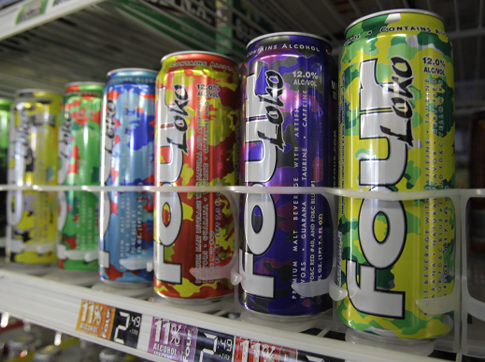
Four Loko Facing Imminent Ban

Wow.  So it’s come to this.  According to the Wall Street Journal, the FDA is set to ban Four Loko, along with other products like Joose (and presumably, Sparks) that combine caffeine with alcohol.  This follows on the heels of a number of states, most recently Massachusetts,  banning the product locally.

The FDA’s main argument is that the caffeine in these drinks give people energy, which misleads them into thinking they aren’t as drunk as they are.   At least that’s an attempt to ground this in science, unlike the feral politicians who are frothing at the opportunity to ban something that can stand in for now as the cause of all alcohol related ills, like drunken car crashes and alcohol poisoning.

I agree with this Boston Globe editorial, which calls these bans “silly and reactionary“, as it labels Four Loko as a singular threat sweeping the nation.   The politicians grandstanding on this issue sweep under the rug the real problems of underage drinking, particularly drunk driving, which have little to do with Four Loko in particular.

The truth is, the 21 year old drinking age has turned older high school students and college students into furtive criminals, maximizing their drunkenness in sleeper cells where the police, college authorities and parents can’t find them.   The relationship between adults and youths over alcohol is counterproductive, as prohibition of popular substances usually is.  I can only imagine what kind of cult status the FDA has bestowed on Four Loko, which young people are sure to squirrel away until the next fad comes along.

As I wrote in my previous post, I am waiting to see the State Liquor Authority ban upscale Manhattan bars from serving Red Bull Vodkas, or, for that matter, my drink of choice, whiskey and coke.  It seems the caffeine, rather than boosting me on Friday evening after a long work week, is simply tricking me into thinking I’m sober.  Maybe I should be served a shot of whiskey alongside a warm can of coke, like some bars I went to in India.

In general, I am against prohibition, especially as a remedy to a much larger social problem. But this case in particular has stirred me because the issue was led by politicians.  Had the FDA quietly done its own study, and concluded, as some of my friends have, that Four Loko is simply more out of control than other stuff on the deli shelf, I wouldn’t have shed a tear.   But in an era when we have many, many serious problems to deal with nationally and locally, I find the politicians behind this ban embarrassing and shameless.

The ban is expected to take effect on December 10, and following a pronouncement that may come as early as tomorrow, shipment’s from manufacturers to distributors are expected to cease.  If you’re planning a Four Loko farewell party, now’s the time to stock up.

Posted in Political ramblings | Tagged , | 1 Comment

Happy Sunday Bedrock Rock

This song will lift up your spirits like nothin’ else. It’s Iggy and the Sandstones rocking out to the “Bedrock Rock“.   Dig on the awesome caveman meets 80s style.

Posted in Music | Tagged , | Leave a comment

Best Opening Track Of All Time?

Motivation was tough on Friday afternoon, and coffee wasn’t helping, but after blasting about thirty seconds of “Rocks Off”, I was already feeling amped.   The blistering opening track to the Rolling Stone’s great album, Exile on Main Street, prompted me to ponder the great album opening tracks of all time.  A great opening track may not lead to a great album, but it’s very hard to make a great album without one.  It’s like running basketball team without a point guard (hi Miami Heat).

I’ve simulated this game before with some friends, and based on that, have included this important caveat:  Track 1 cannot be the best song on the album.  It has to set the tone for the album, not define it. The biggest casualties of this rule are “Smells Like Teen Spirit”, “Gimme Shelter” and “Thunder Road”.  I would include “Tunnels” on that list, though people have forcefully argued that “Rebellion” is a better song, and “Power Out” was the big single anyway.

Without further ado, my top ten album openers of all time:

Honorable Mentions: “Rocks Off” (Rolling Stones, Exile on Main Street); “I Saw Her Standing There” (Beatles, Meet the Beatles/ Please Please Me); “Who Loves The Sun”   (Velvet Underground, Loaded);  “A Sort of Homecoming”  (U2, Unforgettable Fire)

#10: “Holidays In The Sun” (Sex Pistols, Nevermind the Bullocks)

#9:  “Debaser” (Pixies, Doolittle)

#8: “Second Hand News” (Fleetwood Mac, Rumours)

#7: “Break On Through” (Doors, The Doors)

#6: “Boy In The Bubble”  (Paul Simon, Graceland)

#5: Black Dog  (Led Zeppelin, IV) / “Welcome to the Jungle” (Guns n Roses, Appetite for Destruction)

#4: “Wouldn’t It Be Nice” (Beach Boys, Pet Sounds)

#3: “My Name is Jonas” (Weezer, Blue)

#2: “Sgt. Pepper’s Lonely Hearts Club Band” (Beatles, Sgt. Pepper’s Lonely Hearts Club Band)

#1: “Where The Streets Have No Name” (U2, Joshua Tree)

Without the aforementioned restrictions, the list would look a little different:

#10: “Black Dog”

#9: “Miss You” (Rolling Stones, Some Girls)

#8:  “My Name is Jonas”

#7: “Tunnels”  (Arcade Fire, Funeral)

#6: “Like a Rollin’ Stone” (Bob Dylan, Highway 61 Revisted)

#5: “Sgt. Pepper’s Lonely Hearts Club Band”

#4:  “Where The Streets Have No Name”

#3: “Thunder Road”  (Bruce Springsteen, Born to Run)  If I can editorialize here:  “Thunder Road” might be my favorite song of all time, but I place it only third in this category because “Born to Run” would have been a superior choice to start the album.  It has more energy, and doesn’t leave you as emotionally drained after. “Thunder Road” could have been the epic closer that “Jungleland” seeks to be, or even closed the first half of the album, since this was during the vinyl era.

#2: “Gimme Shelter” (Rolling Stones, Let it Bleed)

#1: “Smells Like Teen Spirit”  (Nirvana, Nevermind)

Write in or comment with your own suggestions.

Update: The following comment came in from Russ-

Gone, Black Crowes, Amorica. Iit sets a great tone for an album filled with gems, and when the drums and second guitar kick in, i still freak out. Also, kinda surprised Welcome to the Jungle doesn’t get a mention. And in the first song as potentially best song of the album, what, no Purple Haze?

“Welcome to the Jungle” certainly should be on there.   Duly noted.

Posted in Music | 3 Comments

The Four Loko Battles Come to New York

“Four Loko, and drinks like it, are a toxic, dangerous mix of caffeine and alcohol, and they are spreading like a plague across the country.”

-Senator Chuck Schumer (D-NY)

“Chuck Schumer, and politicians like him, are grandstanders who’d rather go after a malt beverage than get to work solving our country’s problems.”

-Janos Marton (D-NY)

Apparently, politicians are gunning for Four Loko, a caffeinated beverage that is also 11% alcohol.  The accusations start with the age old story of college campus binge drinking, as if college students would have no other ways to drink themselves sick if Four Loko were unavailable.  Do we really have to revisit the tired conversation about whether an 18 year-old drinking age would do more to reduce binge drinking than silly bans on drinking games or individual types of alcohol?

Four Loko is popular among poorer people because it is cheap- $3.50 for a 24-ounce can at my local deli.  Some places you can’t even get an old fashioned 40oz for that cheap.    The price is probably the reason it’s popular among college students, because it tastes terrible and gives vicious hangovers.  Furthermore, students that sleep in until their 11am classes shouldn’t need the caffeine.

Politicians love bogeymen like this, because it’s a way to make positive headlines with older, responsible voters, without doing the job we sent them to do, which is to produce a balanced budget that provides a social safety net and invigorates the economy.  Yeah, I know it’s tough, Senator, but that’s how you’re supposed to earn your title, your intern brigade, your free perks and your media attention.  Not by going after Four Loko.

The FDA is studying the effect of mixing alcohol and caffeine, and I’m as keen as anyone to hear what they discover. After all, Red Bull Vodkas, the official $14 drink of investment bankers, are also potentially dangerous mixes of caffeine and alcohol.    Of course, Schumer would never go after that concoction, because then there would be nothing to serve at his Wall Street fundraisers.

On a local level, City Councilman James Sanders plans to introduce a bill banning Four Loko’s sale in New York City.   If Mayor Bloomberg signs the bill, I hope a reporter asks him whether it was appropriate for his 16 year-old daughter to have a full bar in her wing of the apartment during high school.   Politicians posture, the powerful do as they please, and the country continues to tailspin.   I won’t miss Four Loko if it’s banned, but I already miss the days when politicians at least pretended to work on real problems.

Posted in NYC, Political ramblings | Tagged , | 2 Comments

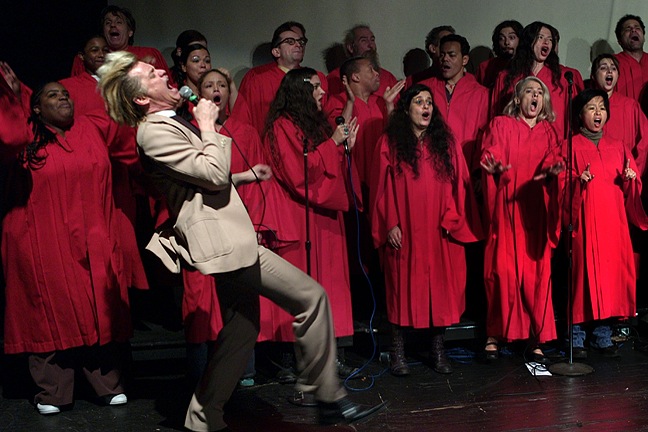
Rev Billy Funraiser- Next Tuesday!

As some of you know, I am on the Board of the Church of Life After Shopping, the organization spearheaded by the Reverend Billy Talen and his partner Savitri D.   The Rev and his choir have raised awareness about local issues like the privatization of Union Square to national issues like mountaintop removal by coal companies.

Next Tuesday will not only be the 10th anniversary of the Church of Life After Shopping, but the funraiser will take place at the group’s new home, Theatre 80, on St. Marks and 1st Avenue.

Here’s an excerpt from the Rev’s description of the event:
Join us on EVIL’S NITE OUT.  Rev Billy’s DIY Gangster Drag Party.  Who wins in the CLIMATE CHANGE CATEGORY – make a plastic water bottle hoop skirt like a FREAK STORM!  In the FAKE BOHO STARBUCKS CATEGORY- Al Capone-like suits from frapuccino cups?  Funraiser for church on our 10th Anniversary. Theatre 80 East Village Mon 11/16 www.revbilly.com

Yes, the theme is Gangsters, as Theatre 80 is an old speakeasy.  Food, drinks and wild performances will be served.

Buy tickets now, and you can get them as low as $25, which will not be the case the night of the event.

Hopefully I’ll see you there!

Posted in Uncategorized | Leave a comment

Get Yourselves Outdoors!

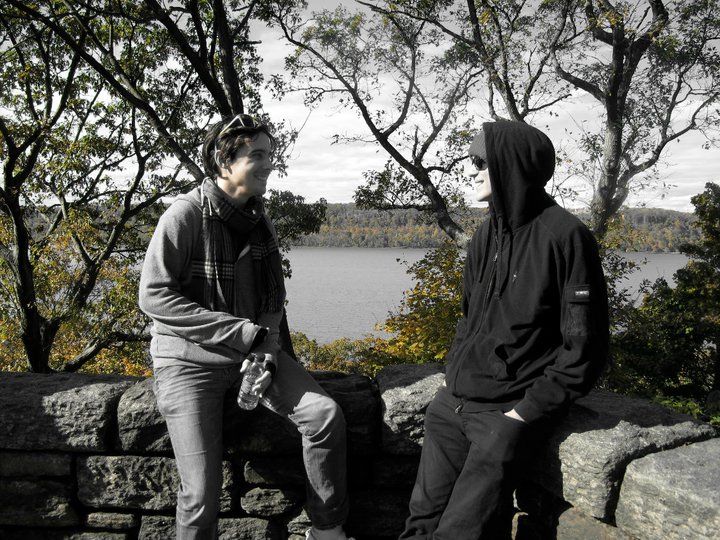
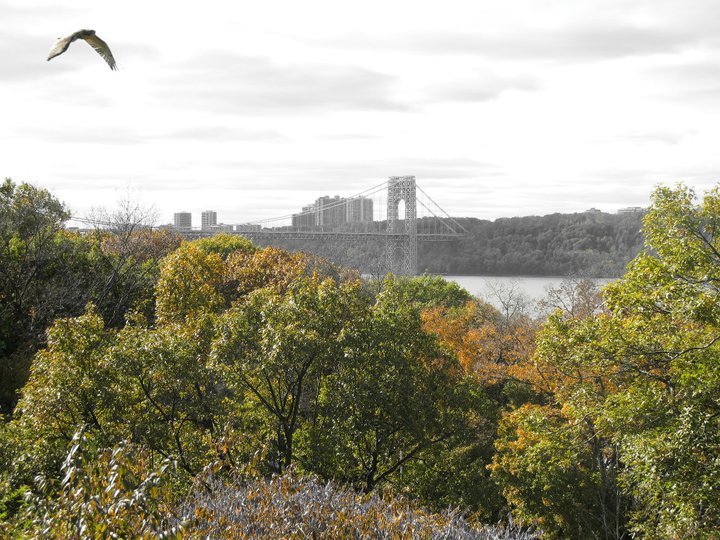
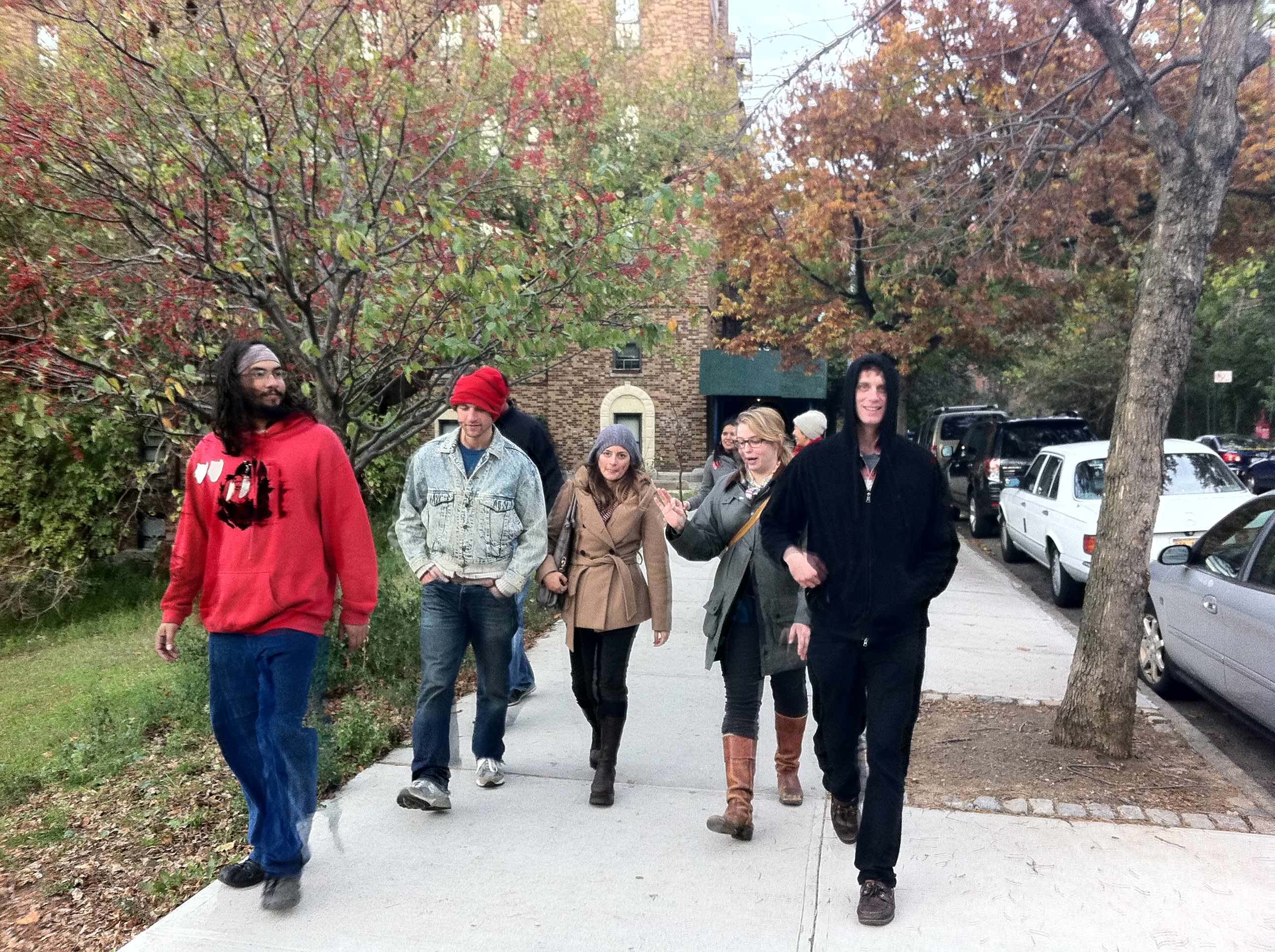
Manhattan is a bigger island than people think when they’re compressed like sardines in subway cars or on midtown streets.  This Saturday a group of us went hiking in the Fort Tryon Park and Inwood Park, which are just around the corner from each other.

Fort Tryon Park is best known for the Cloisters- a medieval style castle which apparently has cool stuff to check out.  We weren’t interested in paying the $20 suggested donation, so we wandered around, and found the Heather Gardens and Allison’s Walkway, both of which are plenty scenic.

While leaf-changing season is probably long over in Vermont and New Hampshire, New York and New Jersey are in full transition, leading to some spectacular views across the river.

Inwood Park is just a few blocks over from Fort Tryon Park.  While the former is moderately populated with folks wandering around post-Cloisters, Inwood Park is virtually empty.  It’s trails loop for miles, and provide for old-school fun activities, like stick jousting.

For everyone who has been craving a day to get out of the city, this is about as easy as it gets.  Both Fort Tryon Park and Inwood Park are accessible via the A Train or the 1 Train.  We took the A Train up to 200th Street, which was perfect for both parks.  If you walk the length of Inwood Park it kicks you out on the northern tip of Manhattan, near the 215th street stop on the A line.

It’s a real treat that in addition to Central Park and Prospect Park, New York is full of little gems like these guys that tend to fly under the radar.


Posted in Hanging out, NYC | Tagged , , | Leave a comment

Time To Get Back To Work

Tuesday night was a tough night for the United States.   The Republicans slaughtered the Democrats, not only winning back the House of Representatives, but also capturing state governments all over the country.  Because Republicans ran on a campaign of opposing President Obama’s every move, we can now expect complete gridlock on all matters of domestic policy for the next two years, as well as two ugly years of teachers being laid off, public transportation projects grounded to a halt, and unemployment benefits slashed.  Money will continue to pour into political campaigns at record levels.  If there’s one message to take away from Tuesday night, however, it’s that we MUST stay involved.

Staying involved means voting, first and foremost.  Tuesday’s turnout numbers were far below 2008 levels, as midterm elections always are.  This befuddles me.   Voting is a core civic duty.  Anyone who cannot make the time to vote from 7am to 8pm, or request an absentee ballot, better have good reason.  One simple explanation for Tuesday’s result is that the demographics of the voters looked a lot more like John McCain’s supporters than Barack Obama’s supporters.    To the many people in my age demographic who have moved around after college or grad school, take this week to update your voter registration.

Staying involved means supporting good local candidates.  While we lost a number of good men and women this past election cycle, most politicians are not irreplaceable.  Because most candidates for Congress, governor or senator are drawn from lower elected positions, we should make sure to support men and women of integrity and intelligence for our local offices.  In New York, one of the few states to weather the Republican wave, we still have far too many corrupt local Democrats.      Support good local candidates, and support them early.

Staying involved means getting active, regardless of what Jon Stewart says.  Check out this exact quote from the webpage of his “Rally to Restore Sanity” rally:  Ours is a rally for the people who’ve been too busy to go to rallies, who actually have lives and families and jobs (or are looking for jobs). While anti-war rallies may not be your ideal gig, there are many ways to stay active- from volunteering with seriously underfunded non-profits in your community to boycotting certain products to simply spreading awareness on Facebook.  Some forms of activism are more effective or visible than others, but everyone should be doing something.

Staying involved means communicating with your family, friends and co-workers.  The joke about political endorsements is that outside a handful of big players, a typical politician’s endorsement can only guarantee the support of his or her family.   What about the apathetic people in your inner circle?  Did you encourage them to vote, and educate them on issues beyond the mainstream news sound-bites?

Staying involved means updating your civics education.  What we all learned about American government in high school and college is simply false.  Even with massive Congressional majorities, President Obama was barely able to carry out major planks of his legislative agenda from 2009-2010, largely due to arcane rules that allow the minority party far too much power and special interest groups that control many of the key players in both parties.  Consider this: Alabama’s Republican Senator, Richard Shelby, held up literally dozens of President Obama’s executive appointments.  He did so single-handedly and secretly.  On what grounds?  Shelby was blocking these appointments so that Alabama could receive more pork spending on his donors’ military contracting projects.  But after a national spotlight was cast on him, Shelby largely backed down.   Politics and governance will always be ugly, but this is the system we have chosen as a nation.   As Winston Churchill once said, “Democracy is the worst form of government, except all those other forms.”   Being aware of how government really works may not improve your day, but it will temper your expectations and help you put your energy in the right place.

Staying involved means not getting discouraged.   The insiders who control local and national politics want you to be discouraged. When fewer people vote, pay attention to the issues and make noise on the streets, backroom deals that help connected individuals and corporations become that much easier.  By tuning out, you only make it easier for things to get worse. Democracy is not a spectator sport.   America has been through worse times than these.  The U.S has had far worse people in office.  The media has been more shallow, the politicians more corrupt.   Let’s shake off Tuesday night and pull ourselves together.  There’s a country out there that needs us.

Posted in Political ramblings | Tagged , | Leave a comment